Blades of the Guardians
A 2026 Chinese wuxia epic directed by Yuen Woo-ping, in which a desert bounty hunter escorts the empire's most wanted man to Chang'an while every faction in the western regions closes in.

At a glance
- Chinese title
- 镖人:风起大漠
- Release
- 17 February 2026
- Director
- Yuen Woo-ping
- Writers
- Su Chaobin, Yu Baimei, Larry Yang Zi, Chan Tai-lee
- Runtime
- 126–130 minutes (sources differ)
- Budget
- approx. $123 million (TMDB)
- Box office
- ¥1.448 billion in China by 20 May 2026
- Language
- Mandarin
- Genre
- Wuxia, action, historical epic
Overview
Blades of the Guardians (Chinese: 镖人:风起大漠, Biao Ren: Feng Qi Da Mo) is a 2026 Chinese wuxia film directed by Yuen Woo-ping, one of the most influential action choreographers in the history of the genre. It stars Wu Jing as Dao Ma, a bounty hunter who accepts a dangerous escort commission, with Nicholas Tse, Yu Shi, Chen Lijun, Sun Yizhou, Tony Leung Ka-fai and Jet Li among the ensemble. The film opened in China on 17 February 2026 and was released in the United States by Well Go USA.
The story is set in the western regions of China during the closing years of the Sui dynasty. Dao Ma, known as the empire's second most wanted fugitive, is entrusted by his benefactor, the chief of the Mo clan, with escorting a mysterious prisoner named Zhi Shi Lang — the most wanted fugitive of all — to the capital at Chang'an. Once the nature of the cargo becomes known, every faction with a stake in the empire's future joins the pursuit. The escort becomes a moving battlefield across desert, mountains and snow.
The film was adapted from the manhua Biao Ren by Xu Xianzhe and was shot with an unusual commitment to physical production: reports describe filming in the Gobi and Yardang landscapes of Xinjiang, with practical riding and combat staged on location and a reduced reliance on green-screen effects. Yuen Woo-ping designed the action around real weapons, horses and terrain, bringing together performers from several generations of martial-arts cinema.
Commercially, the film was a major success. Chinese sources report cumulative mainland box office of 1.448 billion yuan by 20 May 2026, placing it second in the year's domestic chart. It received nominations at the Hundred Flowers Awards and the Golden Rooster Awards, and Yuen Woo-ping won Best Director at the Changchun Film Festival. This guide covers the film's source material, story, cast, production, release, reception and themes.
"A grand martial arts feast is back!" — Official synopsis line, TMDB
Source material: the Biao Ren manhua
The film is based on Biao Ren (镖人), the manhua created by Xu Xianzhe. The original work is set in the turbulent final years of the Sui dynasty and follows the people who live by the code of the biaoren — freelance escorts who transport goods, people and secrets across dangerous territory. The series became known for its dense historical detail, its moral ambiguity and its extremely detailed depict of combat and desert life.
Adapting a long-running comic into a single feature required significant compression. The film keeps the central engine of the source — a reluctant escort mission involving two wanted men — while simplifying the network of political factions that surrounds it in the comics. Viewers coming from the manhua will recognise the visual language of the desert caravans, the layered costumes and the habit of treating a contract as a sacred obligation. Viewers new to the story are given enough context to follow the mission without prior knowledge.
The choice of source matters because Biao Ren belongs to a strand of Chinese historical fiction that takes the mechanisms of power seriously. Its villains are not merely cruel individuals; they are officials, merchants and clan leaders responding rationally to a collapsing order. The film inherits that outlook. Even its most spectacular fight scenes are framed as consequences of political decisions rather than as contests staged for their own sake.
The adaptation also explains the film's scale. A budget in the region of 123 million dollars, as recorded by TMDB, is large for a wuxia production and reflects the cost of building a convincing historical world with physical locations, large casts of performers and extensive action choreography. The source's popularity provided both the material and the audience that made such a budget viable.
Why Biao Ren translates to film
The Biao Ren manhua is built from material that cinema can absorb relatively easily. Its chapters are organised around journeys, commissions and fights rather than around long stretches of internal narration, and its characters are defined by what they do under pressure. Xu Xianzhe's drawings are famously dense — armour, weapons, architecture and landscape are rendered with nearly documentary precision — but the dramatic units are compact. A single chapter often contains a complete encounter with a beginning, reversal and consequence.
That structure maps naturally onto a sequence of film scenes. The escort premise supplies a reason for characters to move through different environments, and the historical setting supplies costumes and architecture that are visually distinctive without requiring explanation. Perhaps most importantly, the source treats physical skill as a form of characterisation. A fighter's technique tells the audience who they are and what they value, which is precisely the language Yuen Woo-ping's choreography uses.
Adaptation still required difficult choices. The comic's political network includes numerous factions whose rivalries accumulate over hundreds of pages. A two-hour film can only carry a subset of those relationships, so the screenplay consolidates opponents into a smaller number of clearly motivated groups. This is visible in the film's progression: the attackers become progressively more organised and politically connected as the escort nears Chang'an, turning a series of ambushes into an escalating argument about who should control the empire.
Another change concerns the tone of the source. The manhua is notably willing to let morally sympathetic characters make cruel decisions, and its humour is dry. The film softens some of that harshness for a theatrical audience but preserves the essential idea that honour is expensive. Dao Ma's choices are never framed as easy, and the film does not pretend that a good outcome erases what it costs to achieve one.
For readers of the original, the most interesting question is not whether the film reproduces every plot point but whether it understands what the source is about. The evidence suggests it does. The desert is not simply a backdrop for fights; it is a place where ordinary laws do not reach and where a personal contract becomes the only reliable form of order. That is the central proposition of Biao Ren, and it survives the translation intact.
Story and setting
The late Sui western regions
The film is set at the edge of the Sui empire, in a region where imperial authority competes with merchant families, local clans and armed wanderers. Chang'an is the centre of power and the destination of the journey; the desert is the space where that power is contested. This geographic opposition drives the entire narrative. Every character who wants something must either control the road to the capital or control what travels along it.
The western regions are populated by people who have slipped between systems: fugitives, escorts, merchants, soldiers without commands and families protecting their own interests. Dao Ma belongs to this world. He is skilled, wanted, and apparently motivated only by payment, but the film gradually reveals that his past contains a debt he has never settled. The escort mission forces him to confront it.
The escort commission
The story begins when Dao Ma accepts a commission from the Mo clan chief, a benefactor who has protected him in the past. The task appears straightforward: deliver a prisoner to Chang'an. The prisoner turns out to be Zhi Shi Lang, the most wanted man in the empire, and the value of delivering him — alive or dead — is enormous. News of the escort spreads, and waves of attackers arrive, each with a different reason to want the prisoner or the bounty.
The journey is structured as a series of escalating encounters. Early pursuers are local bandits and rival escorts; later opponents are trained fighters, clan armies and agents with political motives. Each encounter reveals a little more about Zhi Shi Lang's identity and about why Dao Ma was chosen for the job. The mystery of the prisoner functions as a narrative engine, but the emotional weight sits with the escort: every step towards Chang'an brings him closer to the past he has avoided.
Allies, betrayals and the road to Chang'an
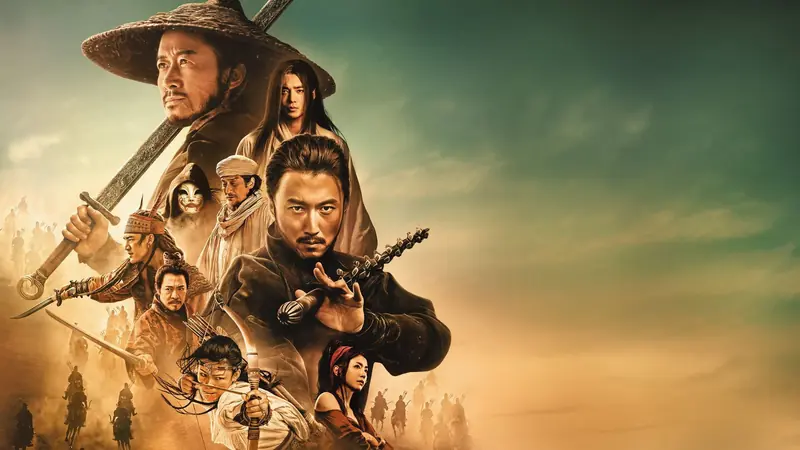
Dao Ma does not travel alone. His companions include fighters whose loyalties are tested as the value of the prisoner becomes clear. Di Ting, played by Nicholas Tse, is one of the film's most important rivals and eventual counterparts: a man whose relationship to Dao Ma is complicated by old obligations and competing codes of honour. Other allies include Ayuya, Shu and members of the Mo clan whose fate is tied to the success of the mission.
As the group moves east, the political stakes widen. The Mo clan chief is killed, and Dao Ma's connection to an earlier act of rescue — he once saved the infant child of a condemned official — becomes significant. The film uses this history to turn a mercenary assignment into a question of identity. Is Dao Ma simply an escort paid to deliver a prisoner, or is he the person his past says he is?
The final movement brings the caravan into the capital's orbit, where the people who wanted the prisoner must face the consequences of their schemes. The resolution respects the source material's moral complexity: loyalty is rewarded, but not every debt can be repaid, and survival is not the same as victory.
The action set pieces
The film's reputation rests on its combat, and the choreography is organised around the idea that terrain is a participant. Rather than staging fights in neutral space and adding scenery later, the action team appears to have designed each sequence around a specific environment. The result is a set of encounters that feel different from one another in both rhythm and risk.
Desert ambushes
The earliest attacks take place in open country. Sand reduces traction, dust obscures distance, and the lack of cover turns every exchange into a visible test of speed and aim. Archery matters here in a way it rarely does in studio wuxia: arrows travel across real distance, and the audience can see the space the characters must cross. Wu Jing's Dao Ma fights with a practical economy, using the minimum movement necessary to survive an encounter rather than performing for an audience.
Mounted sequences
Horseback action is among the most difficult material to film because it combines two unpredictable systems — animals and fighters — in a single frame. Productions often solve this problem with inserts and editing. Here the commitment to real riding means that camera positions are chosen around the animals' movement rather than imposed on it. Chases across the Gobi therefore have a distinctive looseness: riders lean into turns, weapons are awkward at speed, and the physical effort is visible.
The duels
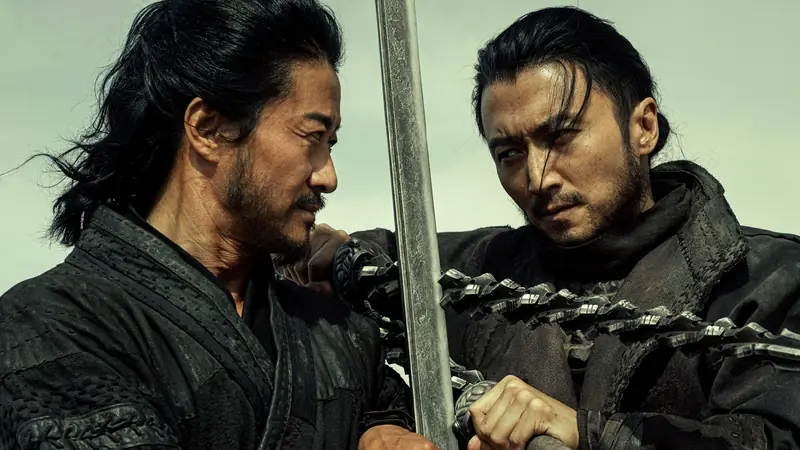
The film's one-to-one fights are staged closer and slower than its group battles. Blades are heavy, armour limits movement, and each strike has a clear preparation and consequence. Nicholas Tse's Di Ting provides the most important contrast to Dao Ma: where Wu Jing's character is compact and direct, Tse's fighting carries a sharper, more theatrical quality. The contrast makes their encounters readable as a clash of two histories rather than two skill sets.
The snow battle
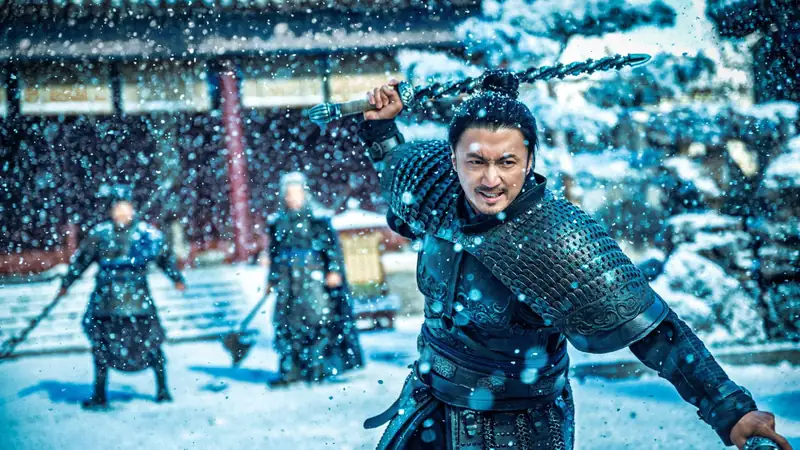
The snow sequence changes the rules again. Cold reduces mobility, bright surfaces reveal movement, and the blue-grey palette removes the warm haze of the desert scenes. The choreography responds with shorter bursts and more reliance on footing. Visually, the sequence functions as a mid-film reset: the audience is reminded that the journey has physical cost and that the escort party is moving through a world that does not accommodate them.
The final confrontation
The climax gathers the political and personal threads into a single confrontation. Its scale is larger than the earlier duels, but its logic is the same: a small number of fighters, a defined space and a decision that cannot be avoided. Because the film has spent its running time establishing who each character is through movement, the final battle does not need lengthy exposition. The audience already understands what is at stake.
Cast and characters
The film assembles performers from several generations of Chinese and Hong Kong, China action cinema. That casting is part of the project's design: Yuen Woo-ping's action system depends on actors who can perform realistic combat rather than rely on editing, and the ensemble includes both established martial-arts stars and newer performers from television, stage and opera.
| Performer | Character | Role in the story |
|---|---|---|
| Wu Jing | Dao Ma | The second most wanted fugitive who takes the escort commission. |
| Nicholas Tse | Di Ting | A formidable fighter whose past connects him to Dao Ma. |
| Yu Shi | Shu | Young fighter travelling with the escort party. |
| Chen Lijun | Ayuya | Companion on the journey, trained in stage combat and opera movement. |
| Sun Yizhou | Zhi Shi Lang | The most wanted fugitive being escorted to Chang'an. |
| Li Yunxiao | Ms. Yanzi | Member of the travelling group. |
| Ci Sha | Heyi Xuan | Fighter drawn into the contest over the prisoner. |
| Tony Leung Ka-fai | Old Mo | The clan chief who entrusts Dao Ma with the mission. |
| Jet Li | Credited in promotional cast listings | Legendary martial artist appearing in the ensemble. |
| Max Zhang | Credited in promotional cast listings | Martial artist and action performer. |
| Kara Wai | Credited in promotional cast listings | Veteran performer from Hong Kong, China cinema. |
| Zhang Yi | Credited in promotional cast listings | Character actor in the ensemble. |
Cast lists differ slightly between the distributor's press materials and international databases, particularly for cameo and supporting roles. The top-billed credits are consistent: Wu Jing as Dao Ma, Nicholas Tse as Di Ting, Yu Shi as Shu and Chen Lijun as Ayuya. Chen Lijun's background in Chinese opera is significant because her movement training translates directly into weapon choreography.
Production
Director and action design
Yuen Woo-ping directed the film and designed its action. His career began in the martial-arts cinema of Hong Kong, China and later included choreography for major international productions. What distinguishes his work is a preference for legible, high-impact movement performed by actors rather than concealed by rapid cutting. In Blades of the Guardians, that approach is applied to swords, spears, bows and horses rather than to the wire-assisted fantasy that dominated earlier wuxia productions.
Reports on the production emphasise "real fighting and real riding" — practical combat and mounted sequences performed on location. This is consistent with the film's visual texture: fights take place on uneven ground, in dust and snow, and the performers' movements are shaped by terrain rather than by a studio floor. The result is a wuxia film that feels physical in a way that many effects-heavy contemporaries do not.
Filming locations and physical production
Principal photography took place in Xinjiang, including the Gobi desert and Yardang landform regions. These locations provided the film's distinctive horizontal composition: vast empty spaces with small groups of people moving across them. Production reports describe a deliberate effort to reduce dependence on green-screen effects, using real landscapes wherever possible. That choice increases the logistical difficulty but gives the film a sense of place that digital backgrounds struggle to reproduce.
The snow sequence required a different environment and a different style of choreography. Cold, blue-toned imagery contrasts with the amber desert that dominates the rest of the film, and combat in snow demands visible footing and breath. The shift is not merely decorative: it signals that the journey has crossed from one kind of danger into another.
Screenplay and structure
The screenplay is credited to Su Chaobin, Yu Baimei, Larry Yang Zi and Chan Tai-lee. Adapting a sprawling comic required decisions about which threads to keep. The film retains the escort mission, the key relationships around Dao Ma and the political stakes surrounding Zhi Shi Lang, while reducing the number of competing factions. The pacing follows the logic of a road movie: each location introduces a new obstacle, a new ally or a new piece of information, and the journey itself supplies the structure.
This approach keeps a long runtime manageable. Rather than pausing for a conventional middle-act subplot, the screenplay uses the road to escalate continuously. The risk of such a structure is repetition, and the film counters it by changing the scale of each confrontation — from single combat to group ambush to full-scale battlefield action.
Four generations of wuxia performers
Production descriptions of the film mention four generations of martial-arts practitioners working together. That is more than a publicity phrase; it describes the film's casting logic. Jet Li represents the generation that made wuxia a global cinematic language in the late twentieth century. Tony Leung Ka-fai and Kara Wai bring the tradition of Hong Kong, China genre acting into the same frame. Wu Jing and Nicholas Tse represent the performers who inherited that tradition and reshaped it for the action cinema of the 2000s and 2010s. Yu Shi, Chen Lijun and others bring newer training, including stage and opera movement.
The practical effect on screen is a wider vocabulary of combat. Older performers favour economical, rooted movements learned in slower-paced production conditions; younger performers bring acrobatic range and different physical disciplines. Yuen Woo-ping's task is to make these styles compatible without flattening them into a single house style. The duels work because each fighter's technique remains identifiable — the audience can tell who is fighting by how they move.
This generational structure also gives the film a thematic dimension. The story concerns people who inherit obligations they did not choose, and the cast embodies a similar inheritance. Each performer carries the history of the genre into the scene. For viewers familiar with martial-arts cinema, the ensemble functions as a living timeline; for viewers who are not, it simply produces a sense that the world is populated by people who have done this before.
Chen Lijun's presence is particularly interesting. Her background in Chinese opera gives her movement a formal precision distinct from film-trained combat. In a production that foregrounds physical authenticity, that difference is an asset: weapon work becomes a form of choreography with its own rules, closer to stage tradition than to the improvised brawls that dominate some modern action films.
Sound, costume and world-building
A film built on practical combat depends heavily on sound design. The contact between blade and armour, the scrape of boots on stone, the movement of horses and the discharge of bows are not decorative effects; they tell the audience how much force is being used and how much protection a character has. The Golden Rooster award for Best Sound Recording given to Wang Yanwei is therefore a recognition of a central craft element rather than a technical footnote.
Costume design works in the same register. The film's clothing is layered and practical enough to suggest real travel, with differences between desert nomads, imperial officials and clan retainers clearly legible at a distance. Because much of the action takes place in wide frames, costumes must communicate identity without close-ups. The same applies to weapons: a character's choice of blade or bow is established early and used consistently, so that later fights carry the accumulated meaning of earlier encounters.
World-building is carried by location rather than exposition. The film rarely stops to explain the political structure of the western regions. Instead, the audience learns it through who controls a pass, who can demand a toll, and who is willing to shelter a fugitive. This is an efficient approach for a long film with a large cast, and it respects the source material's habit of revealing institutions through the behaviour of individuals.
Release and box office
The film was released nationwide in China on 17 February 2026, a date that placed it in the busy lunar new year window. Well Go USA handled the United States release, with the distributor's official listing giving a 130-minute runtime and an R rating for strong bloody violence throughout. International databases list 126 minutes, a small discrepancy common when different cuts are submitted to different markets.
According to Chinese reporting, the film had earned 1.448 billion yuan in mainland China by 20 May 2026, ranking second in the domestic box-office chart for the year. TMDB records a production budget of approximately 123 million dollars and a worldwide revenue figure of just over 203 million dollars. The two sets of numbers are not directly comparable — one is a domestic cumulative figure in yuan and the other a database estimate in dollars — so they should be read as separate indicators rather than as a single accounting.
The commercial result was significant for the wuxia genre. Large-scale martial-arts films had become less frequent in theatrical markets, and the film's performance suggested that an audience remained for a production built around practical combat and historical spectacle. Its release also demonstrated the continuing strength of the Chinese domestic market for event cinema.
International distribution
Well Go USA's involvement placed the film in the company's catalogue of Asian action releases for North American audiences. The distributor's official page gives the English title, a Mandarin-language track, English subtitles, a 130-minute runtime and an R rating for strong bloody violence throughout. That rating is consistent with the film's approach to combat: injuries are visible and the consequences of a fight are not sanitised.
The overseas release also shows how a Chinese historical epic is framed for markets unfamiliar with the source. The English-language synopsis reduces the political background to its essentials — a bounty hunter, a wanted man, a journey and relentless pursuit — and leads with the names of the martial-arts stars. The manhua is mentioned as an origin but not explained in detail. This is standard practice, but it affects reception: viewers outside the source audience are invited to read the film as a genre piece first and an adaptation second.
Chinese-language coverage followed a different path. Reports emphasised the film's production scale, its use of Xinjiang locations and its place in a continuing tradition of wuxia filmmaking. Awards coverage likewise framed the film as a craft achievement within that tradition. The contrast is useful to keep in mind when comparing reviews: the two audiences were often being told different things about what the film was.
For international viewers, the film is most accessible through its action and its structure. The escort plot is easy to follow, the geography is clear and the escalation is steady. The political detail that enriches the manhua is compressed but not essential. What is lost in translation is the sense of a sprawling fictional world; what remains is a self-contained journey with a beginning, a road and a reckoning.
Awards and recognition
The film received several notable nominations and awards during 2026. Chinese sources record a Best Film nomination at the 38th Hundred Flowers Awards in July, a Best Director win for Yuen Woo-ping at the 21st Changchun Film Festival Golden Deer Awards on 28 August, a Best Feature Film nomination at the 39th Golden Rooster Awards on 19 October, and a Best Sound Recording win for Wang Yanwei at the Golden Rooster Awards on 10 November.
Recognition of the sound work is telling. A film built on physical combat depends on sound to make contact feel real: footsteps on sand, blades striking armour, arrows and hoofbeats all carry as much information as the images. That an award went to the recording team rather than only to the action team reflects how much of the film's impact comes from its auditory design.
Themes and analysis
The contract and the wandering hero
At its centre, the film is about a man who accepts a contract and discovers that fulfilment requires more than competence. Dao Ma's profession places him outside ordinary society, but the escort mission forces him back into its obligations. The biaoren code — deliver what you have been entrusted with, regardless of cost — gives the story a clear moral spine without making the hero simple.
Power in a collapsing empire
The late Sui setting is not decorative. The empire is weakening, and every faction is preparing for what comes next. Officials, merchants and clan leaders behave as though political change is inevitable, and their treatment of the prisoner reflects that calculation. The film uses the journey to Chang'an to ask who gets to decide the future when the centre can no longer enforce its laws.
Old debts and inherited guilt
Dao Ma's past — including the child he once saved — gives the film its emotional weight. He is not haunted by a generic crime but by a specific act of responsibility that he has carried silently. The escort mission mirrors that act: once again he is protecting someone whose life depends on him. The parallel allows the screenplay to connect personal honour with public consequence.
Practical spectacle
The film's commitment to real locations and physical performance is also a thematic statement. In a genre often associated with wire work and digital enhancement, Blades of the Guardians insists that bodies occupy real space. The audience is asked to admire not only the outcome of a fight but the difficulty of performing it. That emphasis on craft is consistent with Yuen Woo-ping's career-long argument that action choreography is cinema, not an interruption of it.
Reception and legacy
Early critical response highlighted the film's action as its central achievement. A TMDB review described it as a "Chinese Western" — a lone, rough-hewn character with a questionable past who overcomes personal trauma and does the right thing — and singled out the relentless, polished martial-arts sequences that combine swordplay and archery with the historical setting. Other commentary focused on the film's scale and on the significance of seeing performers from different generations of wuxia share the screen.
The film's awards record suggests that its craft was recognised within the industry, while its box office indicates strong audience interest. As a 2026 release, its longer-term reputation is still forming. What is already clear is its position within a specific moment: a large-budget wuxia production made with practical techniques, released in a year when the genre had become relatively rare at that scale.
For viewers, the film works best when approached as both an adaptation and a piece of action cinema. Knowledge of the manhua enriches the political background, but the escort story stands on its own. Understanding Yuen Woo-ping's history explains why the fights are staged the way they are. Together, those contexts make the difference between watching a sequence of battles and understanding what the film is attempting to revive.
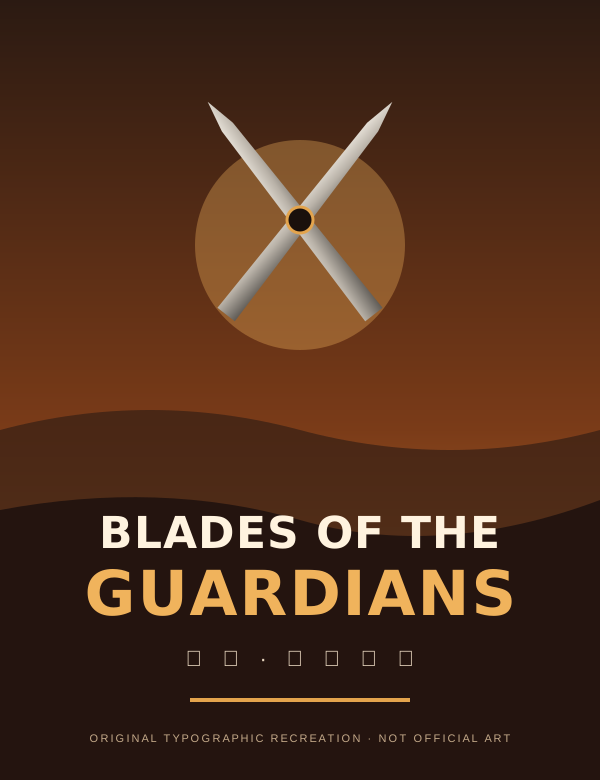
A typographic recreation of the key art
Alongside the promotional photography, this guide includes an original text-based reinterpretation of the film's visual identity. It replaces the ensemble portrait with crossed blades and a desert horizon, using an amber palette drawn from the key art and the Chinese title 镖人:风起大漠. It is offered as commentary, not as official artwork.
Frequently asked questions
When was Blades of the Guardians released?
It opened in China on 17 February 2026 and was released in the United States by Well Go USA.
What is the Chinese title?
镖人:风起大漠, literally "Biao Ren: Wind Rises in the Desert".
Who directed it?
Yuen Woo-ping, the renowned action choreographer and director. He also designed the film's action sequences.
Is it based on a comic?
Yes. It adapts the manhua Biao Ren by Xu Xianzhe, set in the late Sui dynasty.
How long is the film?
Well Go USA lists 130 minutes; TMDB lists 126 minutes. The difference likely reflects different submitted cuts.
How did it perform?
Chinese sources report 1.448 billion yuan in mainland China by 20 May 2026, second in that year's domestic chart. It won several craft awards including Best Director for Yuen Woo-ping.
Sources and external links
- Well Go USA — official film site: synopsis, cast, runtime and rating.
- TMDB — Blades of the Guardians: credits, budget, revenue, artwork and review excerpt.
- Baidu Baike — 镖人:风起大漠: source adaptation, filming locations, box office and awards.
- Douban — 镖人:风起大漠: synopsis and principal cast.
- China Daily — UK premiere coverage: international reception.
This page is an independent, informational fan guide. Blades of the Guardians and all related marks are trademarks of their respective owners. Promotional images are used for identification and commentary.
Reader discussion
Comments appear live. Your name links to your website; links are marked
nofollow. Basic HTML is allowed in comments.Comments
No comments yet. Be the first.